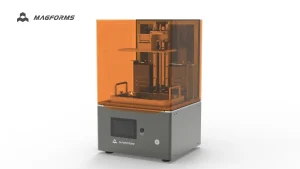
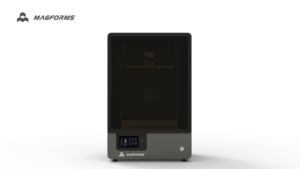
Choosing an industrial SLA 3D printer manufacturer is relatively straightforward if the decision is based only on specifications. Buyers can compare build volume, layer thickness, laser configuration, and stated dimensional accuracy. However, these specifications do not answer one of the questions that matters most after the machine has been installed and put into regular use: Will it still produce consistent parts after months of continuous operation?
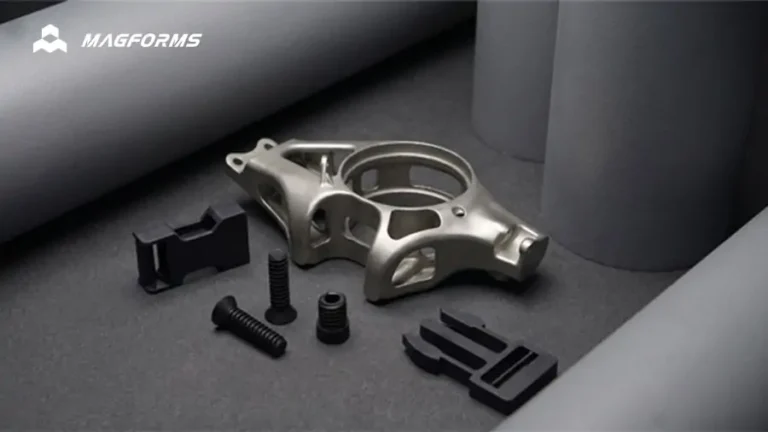
A new industrial SLA 3D printer can produce an impressive first part. Dimensions may be accurate, surfaces may look clean, and the demonstration may go exactly as expected. The more difficult test begins when the machine enters a real working environment and is used repeatedly over an extended period. The same file is printed again and again, the laser continues delivering energy, and the galvanometer repeatedly scans thousands of layers across multiple builds.
That is when long-term stability becomes more than a specification.
The challenge is not simply getting an industrial SLA printer to produce an accurate part once. The real challenge is maintaining accuracy and consistency as the machine continues operating over time.
For buyers evaluating an industrial SLA 3D printer manufacturer, this is why the systems behind long-term printing consistency deserve as much attention as the accuracy listed on a specification sheet.
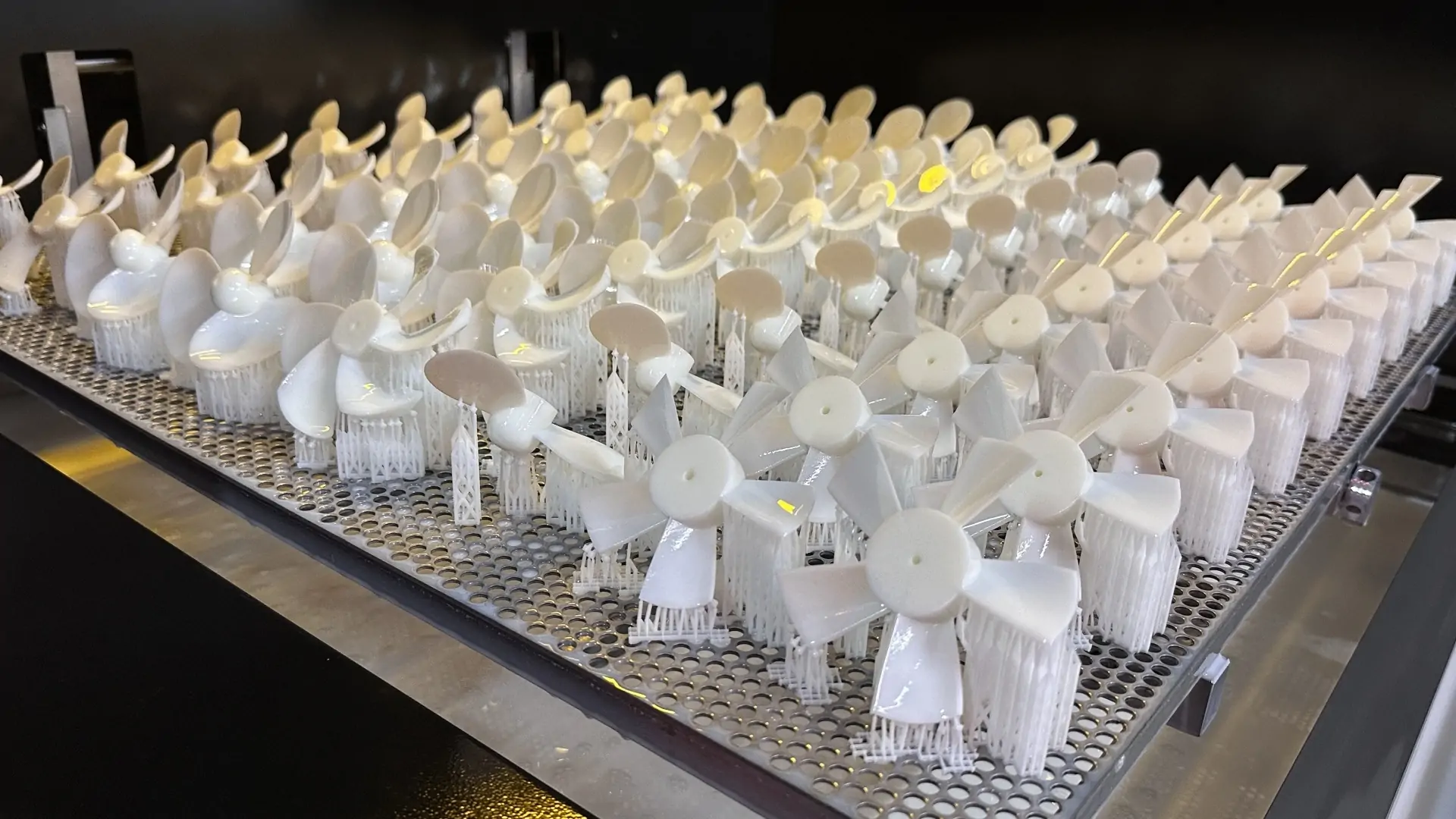
What Makes an Industrial SLA 3D Printer Reliable for Long-Term Use?
This is one of the questions many industrial users consider before investing in a large-format SLA system. A machine may perform well when it is new, but long-term operation introduces a different set of concerns. Will the same model continue to produce similar dimensions? Will fine features remain consistent? Will the printing process gradually require more adjustment to achieve results that were easy to obtain when the machine was first installed?
These concerns are particularly relevant because industrial SLA equipment is rarely purchased for a single demonstration part. It may be used repeatedly for engineering prototypes, large models, tooling patterns, or production-support applications. In these environments, the question is not simply whether the printer can make a good part.
The real question is whether it can keep making good parts consistently.
This is where the difference between initial accuracy and long-term stability becomes important. A successful first print demonstrates that a machine can achieve a particular result under specific conditions, but it does not automatically prove that the same level of consistency will be maintained throughout long-term operation. For industrial users, that distinction can have a direct impact on engineering time, production planning, and confidence in the printing process.
Why Initial Accuracy Is Not Enough for Long-Term Industrial SLA Printing
In the industrial 3D printing market, accuracy specifications are relatively easy to compare. A manufacturer can provide a dimensional tolerance, a supplier can show a successful sample, and a demonstration can confirm that the machine is capable of producing detailed parts. These are all useful reference points, but they represent only part of the picture.
Long-term consistency is more difficult to evaluate because an industrial SLA 3D printer depends on the repeated interaction of several systems throughout every build. Laser energy must be delivered consistently, the scanning path must remain controlled, the resin must respond predictably to the exposure process, and the machine must support this process through repeated operation.
In simplified form, the process follows a continuous chain:
Laser energy → Scanning path → Resin curing → Part geometry
This chain is repeated layer by layer, build after build. If the systems responsible for delivering energy and controlling the scanning path do not perform consistently, the printing process itself can become more difficult to predict.
That leads to an important industry distinction: initial accuracy and long-term consistency are not exactly the same thing. A printer may demonstrate strong dimensional capability when new, but maintaining predictable performance over time also depends on the stability of the systems responsible for curing and scanning.
For a laser-based industrial SLA system, two components sit at the center of that process: the laser and the galvanometer.
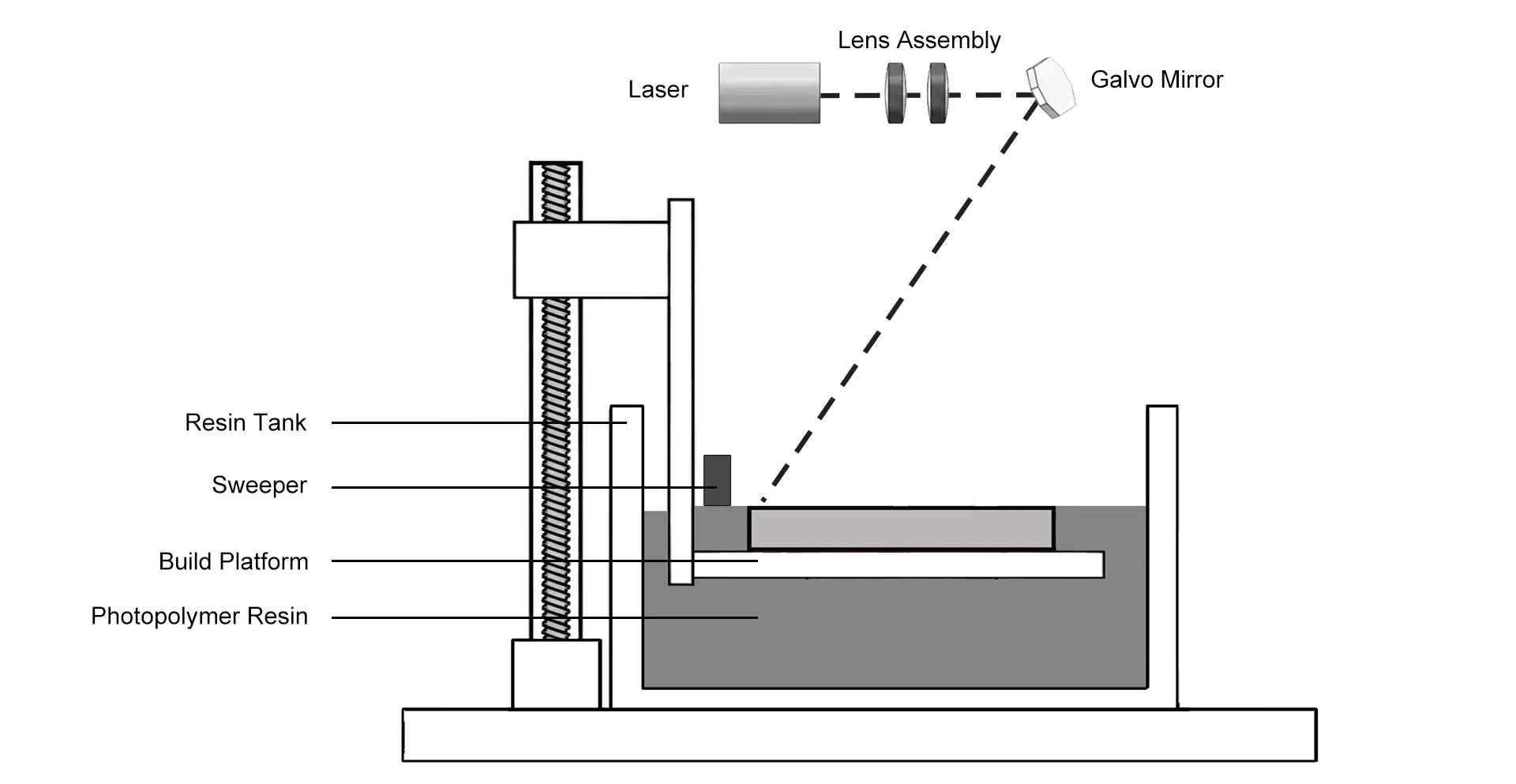
To better understand why laser energy delivery and scanning accuracy are so important, it is helpful to first understand how industrial SLA 3D printing works.
The laser determines how curing energy is delivered, while the galvanometer controls where that energy is directed. For buyers trying to understand whether an industrial SLA system has been designed with long-term consistency in mind, these are two of the most important systems to examine.
Why the Laser and Galvanometer Are the Core of Long-Term SLA Stability
An industrial SLA machine contains many mechanical, electrical, and optical components, but not every component directly determines how the resin is exposed and how the laser follows the intended geometry. The laser and galvanometer play a central role in this process, which is why the optical system deserves closer attention when evaluating an industrial SLA 3D printer supplier or manufacturer.
1. The Laser Determines How Energy Is Delivered
Industrial SLA printing relies on controlled laser energy to cure photopolymer resin. During printing, the laser repeatedly exposes specific areas of the resin according to the geometry defined by the digital model, gradually forming the part layer by layer. Because this process is repeated throughout an entire build and across many future builds, the role of the laser extends beyond simply providing enough energy to cure the material.
The more relevant question for long-term industrial use is whether the optical system can continue delivering controlled and stable energy throughout repeated operation. Changes in energy delivery can influence the curing process, which in turn may affect the consistency of the printed result.
For this reason, the laser should not be viewed simply as another item on a component list. It is the starting point of the SLA curing process and one of the core systems that determines how consistently the material is exposed during printing.
2. The Galvanometer Determines Where the Laser Goes
Stable energy delivery alone is not enough. The laser must also be directed accurately along the intended scanning path, and this is the role of the galvanometer.
During printing, the galvanometer controls the movement of the laser beam across the resin surface. Its function directly influences where the curing energy is applied and how the geometry of each layer is formed. In practical terms, the laser provides the energy, while the galvanometer controls where that energy goes.
This is why the laser and galvanometer should be considered as part of the same system rather than two unrelated components. A stable laser cannot compensate for an inaccurate scanning path, just as precise scanning cannot fully compensate for inconsistent energy delivery.
For long-term print consistency, both systems need to work together. Stable energy must be delivered to the intended location, repeatedly and predictably.
3. Premium Components Alone Are Not the Whole Story
The industrial equipment market often places significant attention on component brands, and for good reason: the quality and reliability of critical components can influence the overall performance of the system. However, a list of well-known brands does not automatically guarantee long-term stability.
The laser does not operate independently from the scanning system, and the galvanometer does not operate independently from the machine supporting it. The final printing result depends on how the optical system is integrated into the complete machine and how consistently these systems work together over repeated operation.
For this reason, buyers evaluating an industrial SLA 3D printer manufacturer should look beyond a simple question such as, “Which laser does the machine use?” A more useful question is to understand which galvanometer controls the scanning, how the optical system is integrated, and how the machine provides a stable foundation for these precision components.
That is where complete system design becomes more important than a specification sheet filled with individual component names.
Why Machine Structure Matters for Industrial SLA Print Stability
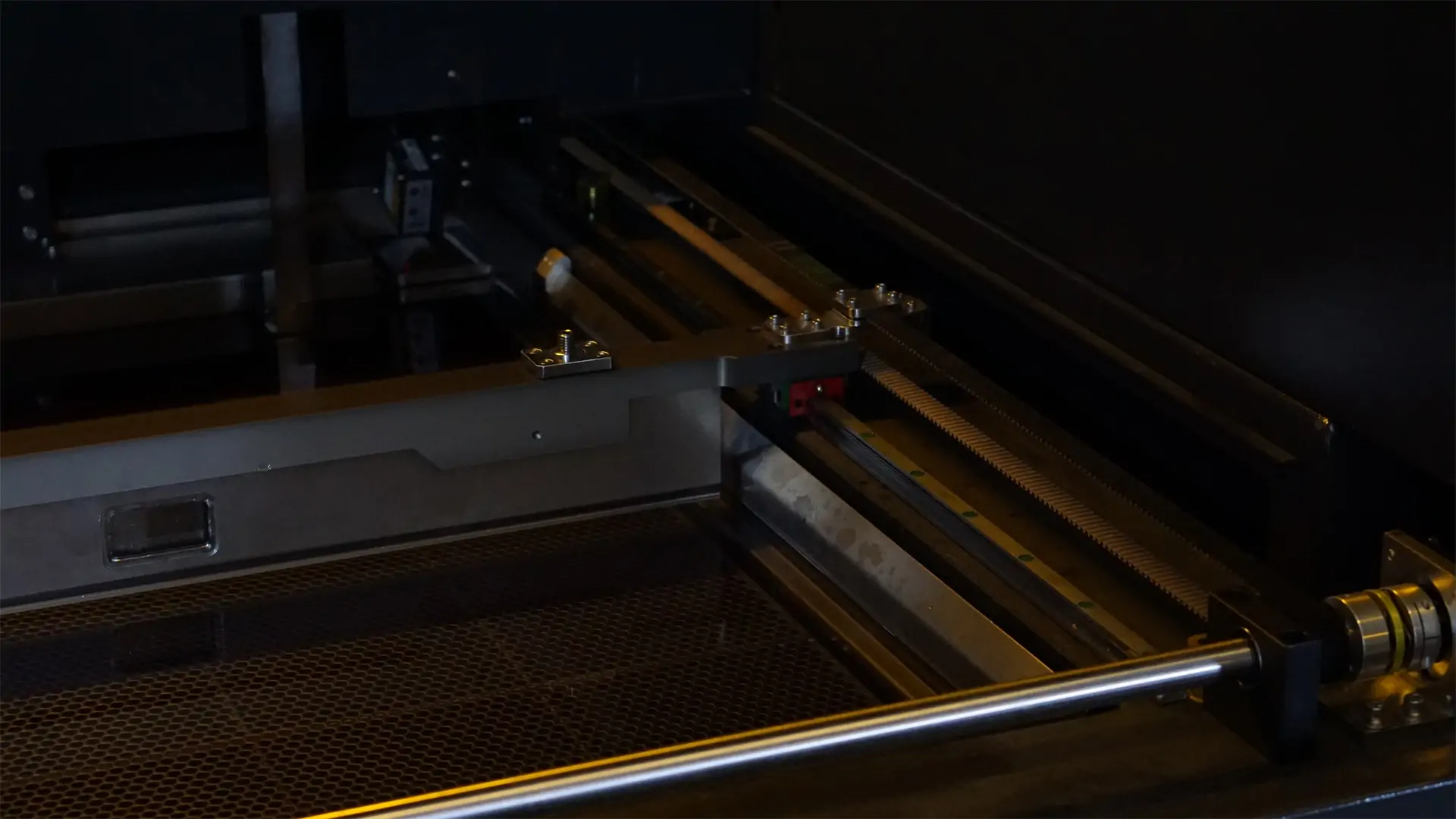
The laser and galvanometer are the central focus of this article, but a precision optical system does not operate in isolation. It is installed inside a physical machine, and the stability of that machine provides the foundation for the systems responsible for scanning and curing.
For the SL800, two structural design details support this foundation: a machine structure using ≥2 mm sheet metal and an adjustable marble platform.
These are not separate headline selling points competing with the optical system. Their purpose is to support the stability of the complete machine. A large-format industrial SLA 3D printer is designed to perform repeated precision operations, and the optical system requires a stable mechanical environment in which to operate.
The engineering logic is straightforward: a precision system needs a stable foundation.
The SL800 uses sheet metal with a minimum thickness of 2 mm to support the overall structure, while the adjustable marble platform provides a stable and adjustable mechanical reference. These design choices are intended to support the precision systems installed within the machine rather than simply making the equipment heavier or more complex.
What Can You Actually Verify Before Choosing an Industrial SLA 3D Printer Manufacturer?
Claims such as “high stability” and “long-term reliability” are common in industrial equipment marketing. The more useful question for buyers is what they can actually verify before making an investment.
When evaluating an industrial SLA 3D printer manufacturer, especially for applications that require repeatable dimensional performance, it is worth examining the systems directly involved in the printing process rather than relying only on general reliability claims.
For the SL800, the confirmed configuration includes the following:
| What to Verify | SL800 Configuration | Why It Matters |
| Laser system | AOC Laser | Provides the curing energy used in the SLA process |
| Galvanometer | German Scanlab galvanometer | Controls the laser scanning path |
| Machine structure | ≥2 mm sheet metal | Provides structural support for the complete system |
| Mechanical reference | Adjustable marble platform | Supports a stable and adjustable machine foundation |
| Stated dimensional accuracy | L ≤ 100 mm: ±0.15 mm; L > 100 mm: ±0.15% × L | Defines the machine’s stated dimensional capability |
| Printing technology | Industrial 355 nm laser SLA | Defines the laser-based industrial SLA process |
These are specific machine facts that buyers can use as part of their evaluation. At the same time, it is important to understand what specifications alone can and cannot prove.
The stated dimensional accuracy defines the machine’s specified dimensional capability, but it should not be interpreted as a guarantee that identical results will be maintained indefinitely under every material, operating condition, or application scenario. Long-term consistency can also be influenced by resin behavior, process parameters, environmental conditions, maintenance, and the specific geometry being printed.
For applications with particularly strict consistency requirements, the most meaningful evaluation should combine machine specifications with application-specific testing. Buyers can ask the manufacturer or industrial SLA 3D printer supplier to provide relevant samples, repeat-build evaluations, or technical discussions based on their actual application requirements.
Buyers comparing different machine configurations can also explore industrial SLA 3D printer systems designed for large-format engineering and manufacturing applications.
How Does Optical System Stability Improve Print Consistency?
The technical value of a stable optical system becomes meaningful only when it improves the customer’s actual workflow. For an industrial user, the benefit is not simply that the machine contains a recognized laser or galvanometer brand. The real value lies in supporting a printing process that is easier to predict and manage over time.
1. More Confidence in Repeat Printing
The first successful part is important, but many industrial applications require the same design to be printed repeatedly. Engineers and production teams need confidence that the next build can follow a predictable process rather than requiring unnecessary adjustments each time.
A stable optical system supports the consistency required for repeat printing by providing a reliable foundation for controlled energy delivery and laser scanning. While application results will always depend on factors such as materials, parameters, and geometry, the stability of the core optical system remains an important part of maintaining a predictable process.
2. Less Time Spent Chasing Small Changes
When a printing process becomes difficult to predict, the cost is not limited to a single unsuccessful part. Engineering teams may spend additional time checking dimensions, adjusting parameters, repeating builds, and trying to identify why a previously successful process is no longer producing the expected result.
Those small adjustments can gradually consume machine time, material, and engineering resources. For industrial users, long-term consistency is therefore closely connected to process efficiency.
The goal is not to eliminate every possible adjustment from industrial production. It is to create a system in which the printing process remains predictable enough that teams can spend more time producing parts and less time chasing unexplained changes.
3. Greater Confidence in Long-Term Use
Industrial equipment is generally purchased to support an ongoing workflow rather than to produce a single demonstration sample. Whether the application involves engineering prototypes, tooling patterns, or repeated production-support parts, users need confidence that the machine can continue supporting a stable process as it remains in operation.
That is the practical meaning of long-term stability. It is not simply a marketing term describing a machine as “reliable.” Instead, it is the ability to support a process that remains manageable and predictable over time.
The goal is not just to buy a printer that produces one impressive part. It is to build a printing process that can continue producing predictable results.
Where Does Long-Term Print Consistency Matter in Industrial SLA Applications?
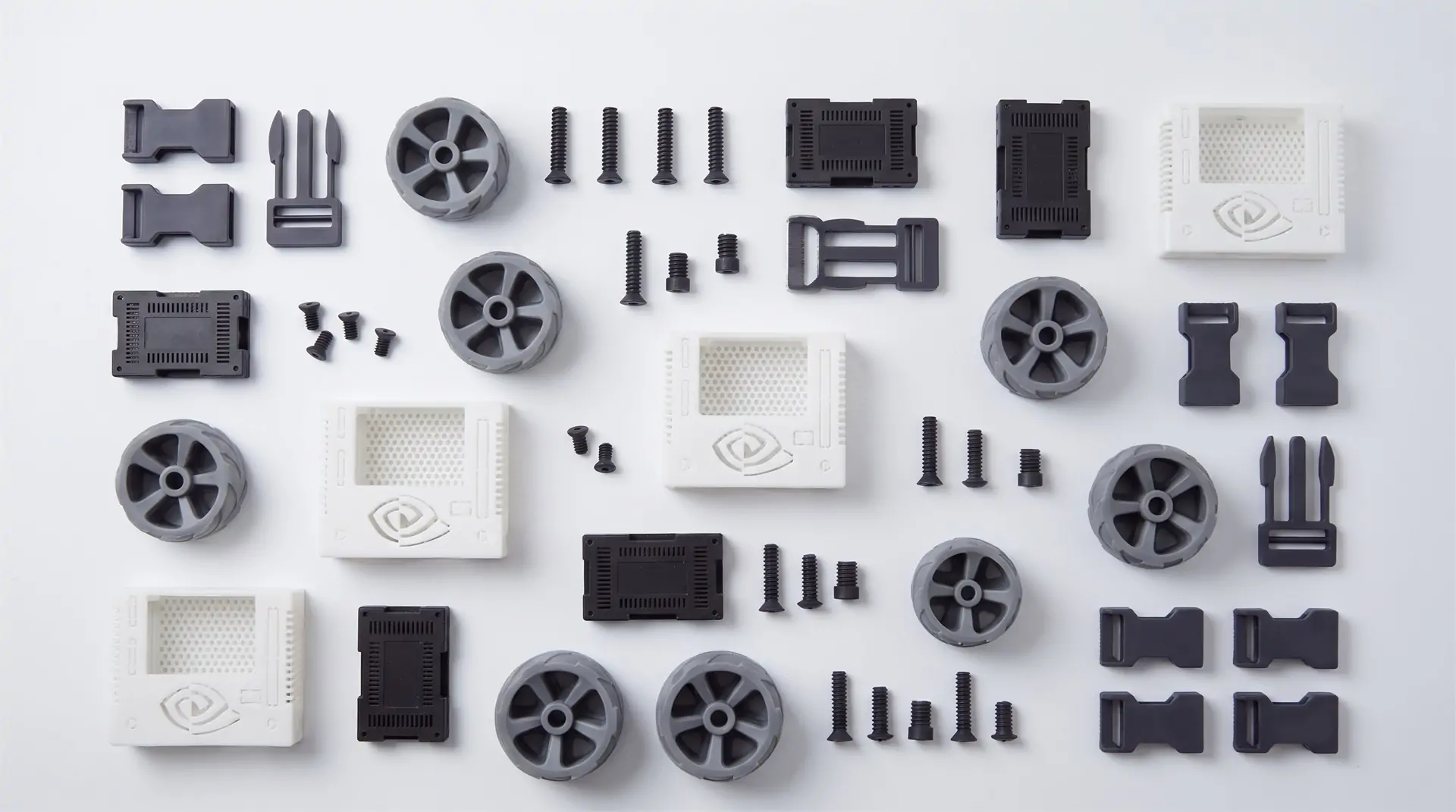
Long-term consistency becomes particularly important when an industrial SLA 3D printer is used repeatedly as part of an engineering or manufacturing workflow, where each build is connected to a larger development or production process.
Engineering Prototyping
Engineering teams may repeatedly produce functional prototypes, assembly verification parts, large concept models, and design validation components. In these applications, a single successful print is useful, but repeated builds are often more important because the development process depends on being able to reproduce similar results without unnecessary interruptions.
If each new build requires significant troubleshooting or parameter adjustment, the efficiency advantage of additive manufacturing can quickly diminish. A more predictable printing process allows engineering teams to focus on evaluating the part itself rather than repeatedly questioning the consistency of the equipment.
Manufacturing and Production Support
Industrial SLA systems can also support applications such as tooling patterns, fixtures, manufacturing aids, and repeated engineering components. Although these applications may not involve traditional mass production, consistency is still important because the printed parts often support other steps in the manufacturing process.
The question is therefore not simply whether the printer can produce a particular part once. It is whether similar parts can continue to be produced through a process that remains understandable and predictable.
A reliable industrial printing process is not defined only by whether the first part succeeds. It is also defined by how consistently the process performs as printing continues.
For a closer look at how these capabilities are applied in real projects, explore industrial SLA 3D printing applications across engineering and manufacturing workflows.
Frequently Asked Questions About Industrial SLA 3D Printers
1.Why is the laser important for long-term industrial SLA printing?
The laser provides the energy used to cure photopolymer resin. Because SLA printing depends on controlled energy delivery throughout every layer of a build, the laser is a core part of the printing process. Long-term consistency depends on the complete system, including the laser, galvanometer, mechanical structure, material, process parameters, and operating conditions.
2.How does the galvanometer affect print consistency?
The galvanometer controls the path of the laser beam across the resin surface and determines where curing energy is applied during the scanning process. Accurate and repeatable scanning is therefore an important part of forming the intended geometry and supporting consistent printing results.
3.Can a printer have good initial accuracy but still require more adjustment over time?
Yes. A successful initial print demonstrates that the machine can achieve a particular result under specific conditions, but long-term performance can be influenced by multiple factors, including the optical system, mechanical systems, material behavior, maintenance, operating conditions, and process parameters. Buyers should evaluate equipment based on their actual application requirements.
4.What should I ask an industrial SLA 3D printer manufacturer about long-term consistency?
Ask which laser and galvanometer systems are used, how the optical system is integrated into the machine, how the precision system is supported by the overall structure, what the stated dimensional accuracy is, and whether application-specific samples or repeat-build testing can be provided.
5.Why do machine structure and platform stability matter if the optical system is already high quality?
The optical system operates within a physical machine, and the machine structure provides the foundation supporting the complete precision system. A stable optical system therefore benefits from a stable mechanical environment, particularly when the equipment is expected to perform repeated precision operations over an extended period.
How Magforms Approaches Long-Term Industrial SLA Stability
When evaluating an industrial SLA 3D printer manufacturer, it is natural to begin with specifications such as build size, stated accuracy, and printing speed. For industrial users planning long-term operation, however, it is also worth examining the core systems responsible for delivering and controlling the laser energy used to form each part.
The SL800 uses an AOC Laser and a German Scanlab galvanometer as its core optical and scanning system. The laser provides the curing energy used in the industrial 355 nm SLA process, while the galvanometer controls the path of the laser beam as each layer is scanned.
To provide a stable foundation for this precision system, the SL800 also incorporates a machine structure using ≥2 mm sheet metal and an adjustable marble platform. These design elements support a simple engineering principle: long-term print consistency depends not only on the precision of the optical system, but also on the stability of the machine supporting it.
The SL800 provides a build volume of 800 × 800 × 550 mm and a stated dimensional accuracy of:
- L ≤ 100 mm: ±0.15 mm
- L > 100 mm: ±0.15% × L
These specifications should be evaluated alongside the optical system, machine structure, material selection, process requirements, and the customer’s actual application conditions.
A reliable industrial SLA 3D printer should not be judged only by how well it performs when it is new. For users planning long-term engineering or manufacturing applications, an equally important question is whether the machine is built around the systems required to support a predictable printing process over time.
If you are evaluating an industrial SLA 3D printer manufacturer for applications that require repeatable dimensional performance, explore the SL800 industrial SLA 3D printer and assess whether its optical system and machine configuration match your long-term application requirements.