If you are choosing between an Industrial SLA 3D Printer and DLP, the decision should not start with which technology is faster. It should start with what you need to produce.
DLP can be highly productive for small, detailed parts because it exposes an entire layer at once. An Industrial SLA 3D Printer, meanwhile, can offer greater flexibility for large-format prototypes, large components, mixed-size production, and applications where material choice and large-area consistency matter.
So which technology is better?
There is no universal winner. The better choice depends on your part size, required accuracy, production volume, material requirements, and overall workflow.
This guide compares SLA vs DLP across the factors that matter most in industrial production, then explains when DLP makes sense and when an Industrial SLA 3D Printer becomes the stronger option.
SLA vs DLP: How Do the Technologies Work?
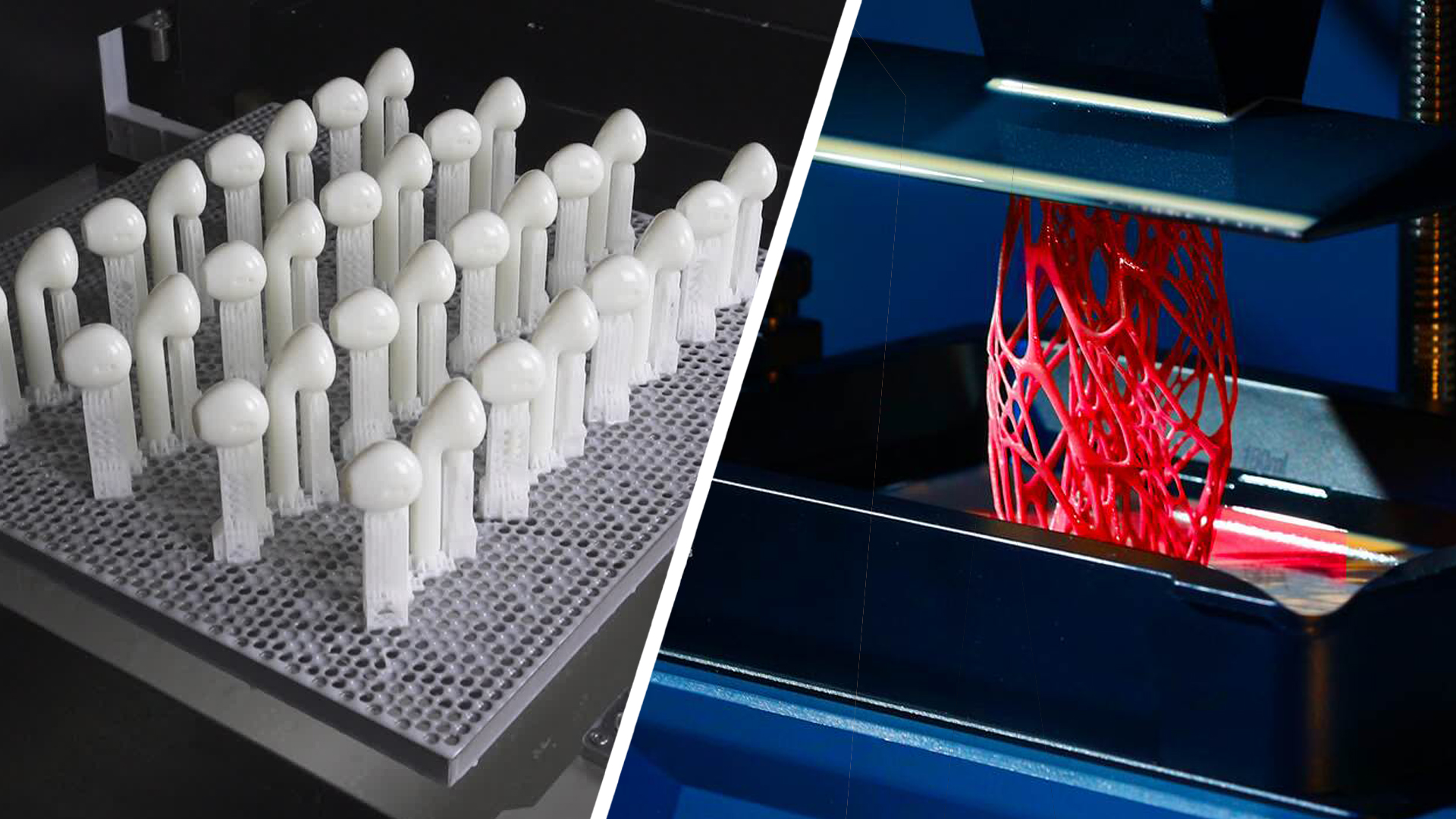
SLA and DLP are both vat photopolymerization technologies. Both use light to cure liquid photopolymer resin layer by layer, but they deliver light to the resin in different ways.
An SLA system uses a UV laser and galvanometers to scan the geometry of each layer. The laser follows the contours defined by the digital model, selectively curing the resin as it moves across the build area.
DLP uses a digital projector to display an optical image of the entire layer. Instead of tracing each feature individually with a laser, the projected image cures the corresponding area of resin simultaneously.
The fundamental difference can be summarized as follows:
| Technology | Light Source | How Each Layer Is Cured | Basic Exposure Method |
| SLA | UV laser | Laser scans the layer geometry along controlled paths | Selective laser scanning |
| DLP | Digital projector | Projected image cures the layer pattern simultaneously | Full-layer projection |
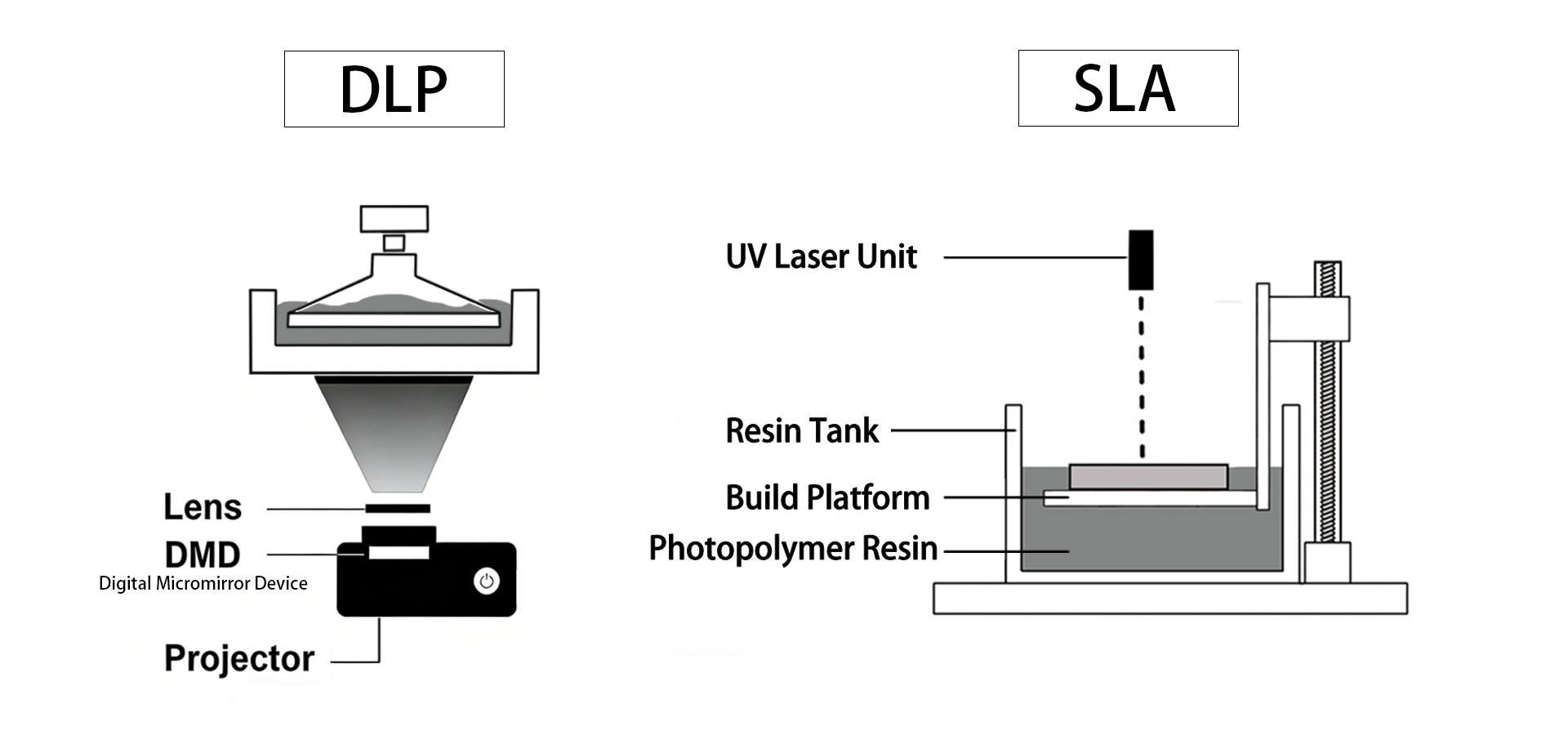
In simple terms:
SLA scans the geometry. DLP projects the geometry.
This difference in light delivery is the foundation for the performance differences discussed in the next section. For readers who want a deeper explanation of stereolithography itself, see how stereolithography 3D printing works.
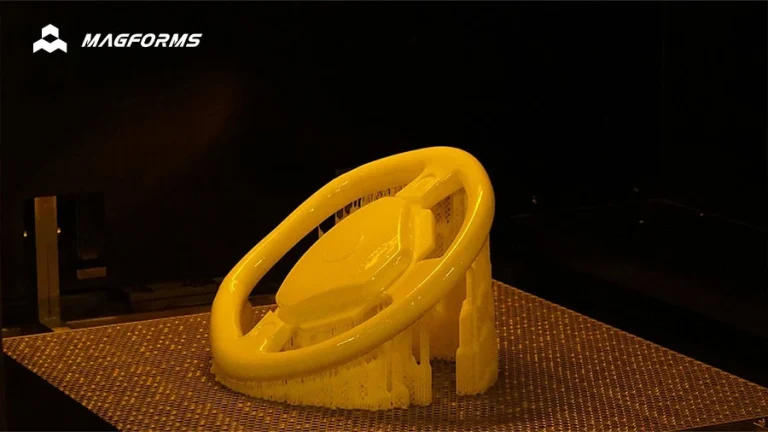
Industrial SLA 3D Printer vs DLP: Key Differences
The most useful way to compare SLA and DLP for industrial production is not to ask which specification looks better on paper. Instead, consider how each technology affects the complete production job.
Accuracy and surface quality are important for both technologies. DLP can deliver excellent detail, while its dimensional performance depends partly on pixel size, optical calibration, and exposure uniformity. SLA uses a focused laser and galvanometer system, providing direct control over the scanning process. For industrial applications, the important question is not simply the smallest feature a printer can reproduce, but how consistently it can reproduce the required geometry across the build area.
Build volume becomes increasingly important as part size increases. A smaller system may expose a layer quickly, but that advantage becomes less meaningful if a large component must be divided into several sections and assembled afterward. The SL800, for example, provides an 800 × 800 × 550 mm build volume, allowing large prototypes and components to be produced with fewer part splits. This can reduce assembly work and the dimensional variation introduced at joints.
Printing speed should be evaluated as production throughput, not exposure time alone. DLP has a natural advantage when an entire layer can be exposed simultaneously. However, total production time also includes recoating, layer height, build arrangement, supports, and post-processing. The key question is therefore not “Which printer has the fastest layer?” but “Which printer produces my parts faster?”
For an Industrial SLA 3D Printer, laser control can also improve productivity. The SL800 uses variable laser spot technology to balance scanning efficiency and detail requirements, with Magforms reporting a 30–50% speed improvement compared with traditional SLA printing.
Large-part consistency is another major differentiator. As the build area grows, optical stability, galvanometer accuracy, motion control, resin management, and recoating all become increasingly important. A printer that performs well on a small test piece may not automatically deliver the same consistency across a large industrial build.
Material flexibility also affects long-term production decisions. Some printing ecosystems restrict users to proprietary materials, while an open material system gives manufacturers more freedom to evaluate compatible resins based on application requirements, availability, and cost. The SL800 is designed to work with most 355 nm resins, providing greater flexibility for different industrial applications.
Finally, consider production scalability. DLP can be highly efficient when production consists primarily of dense batches of small components. An Industrial SLA 3D Printer becomes increasingly attractive when the workload includes large prototypes, tooling patterns, large models, or mixed-size jobs.
The practical takeaway is simple:
The more your production shifts toward large parts and industrial workflows, the more weight should be given to build volume, large-area consistency, material flexibility, and total usable throughput.
When Is DLP the Better Choice?
DLP should not be treated as merely the technology that loses the comparison.
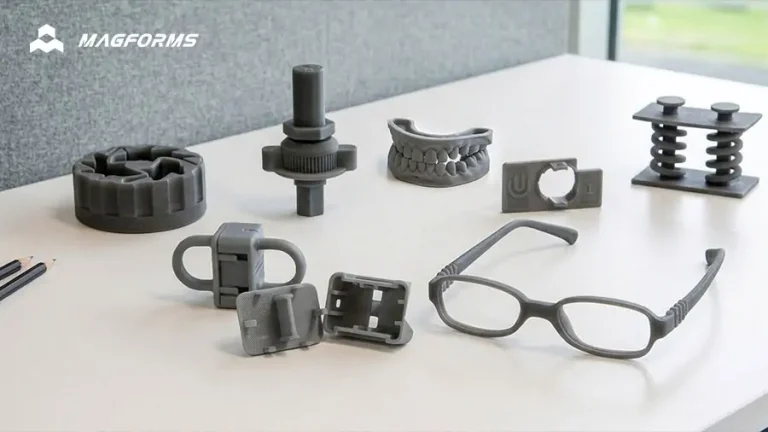
If most of your production consists of small, highly detailed parts that can be densely arranged within a relatively compact build area, DLP may provide excellent productivity. Its ability to expose an entire layer simultaneously can be particularly useful for applications such as dental models, jewelry patterns, miniature components, and other small-format parts.
DLP can also be a sensible choice when a manufacturer already has an established workflow around a specific projector resolution, resin system, and post-processing process.
The key is production mix.
If the majority of your jobs are small and detail-heavy, DLP’s full-layer exposure can be a meaningful advantage. If large components account for a significant share of production, however, build volume and large-area consistency may become more important than layer exposure speed.
That is where industrial SLA begins to offer a different value proposition.
When Is an Industrial SLA 3D Printer the Better Choice?
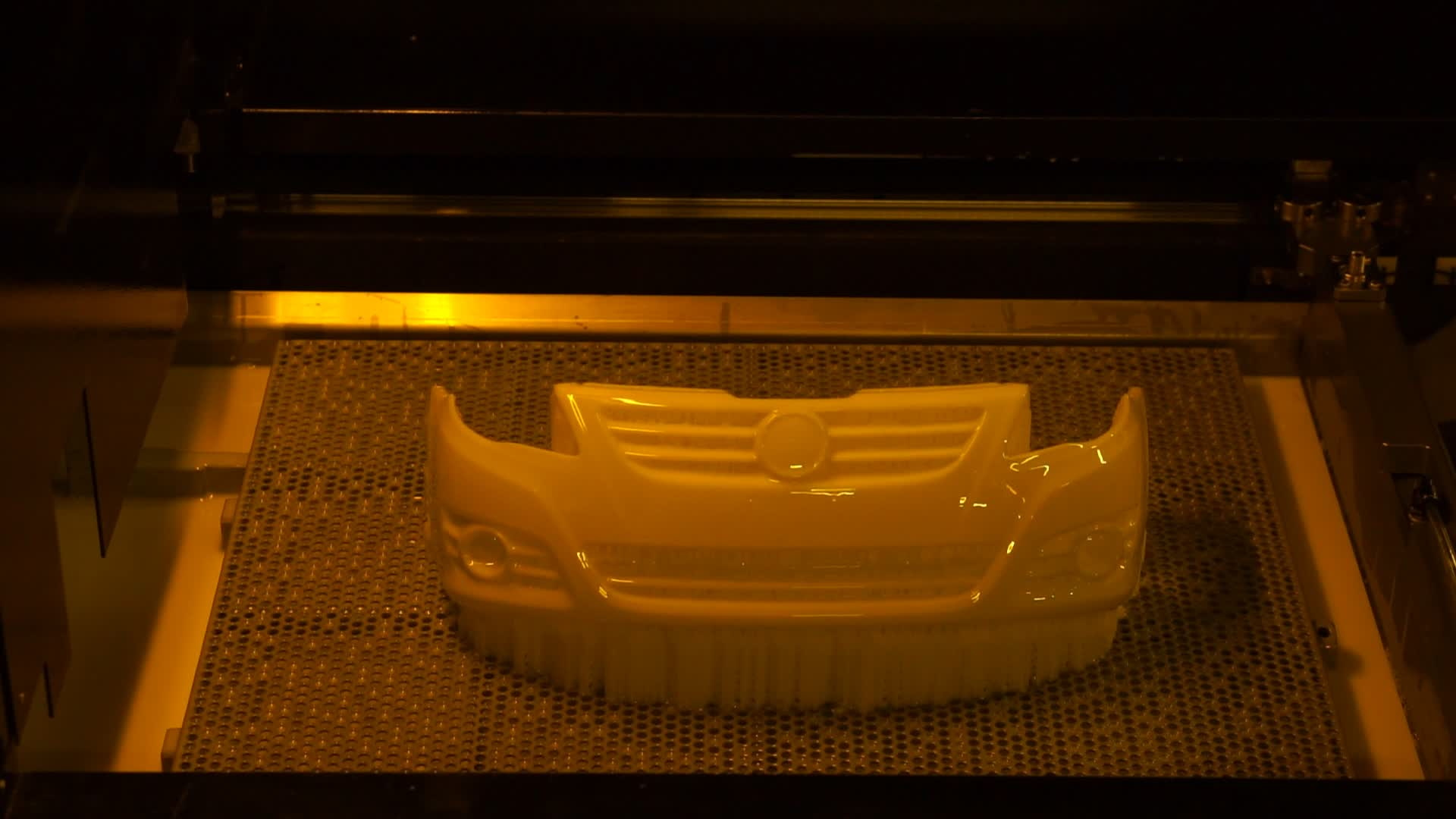
An Industrial SLA 3D Printer becomes particularly attractive when manufacturers need to combine large-format capacity, surface quality, dimensional consistency, and material flexibility in one production workflow.
Start with part size. Large automotive prototypes, equipment housings, industrial assemblies, visual models, and tooling masters can quickly exceed the practical build envelope of compact resin systems. A larger SLA platform can reduce the need to split a model into multiple sections.
Then consider production flexibility. A large build area is useful not only for one large component, but also for arranging multiple parts in a single production cycle. This can make the printer more adaptable to changing production requirements.
Material strategy matters as well. Manufacturers working across different applications may need resins with different mechanical, visual, or processing characteristics. An open material approach can provide more freedom to evaluate compatible materials instead of building the entire workflow around one proprietary material ecosystem.
Most importantly, industrial printing should be evaluated as a complete production system. Optical stability, motion components, resin handling, software, post-processing, maintenance, and material availability can all affect real-world productivity.
For manufacturers exploring different system sizes and configurations, industrial SLA printers offer a broader range of solutions for industrial prototyping and production applications.
Why the SL800 Is Designed for Large-Format Industrial SLA Printing
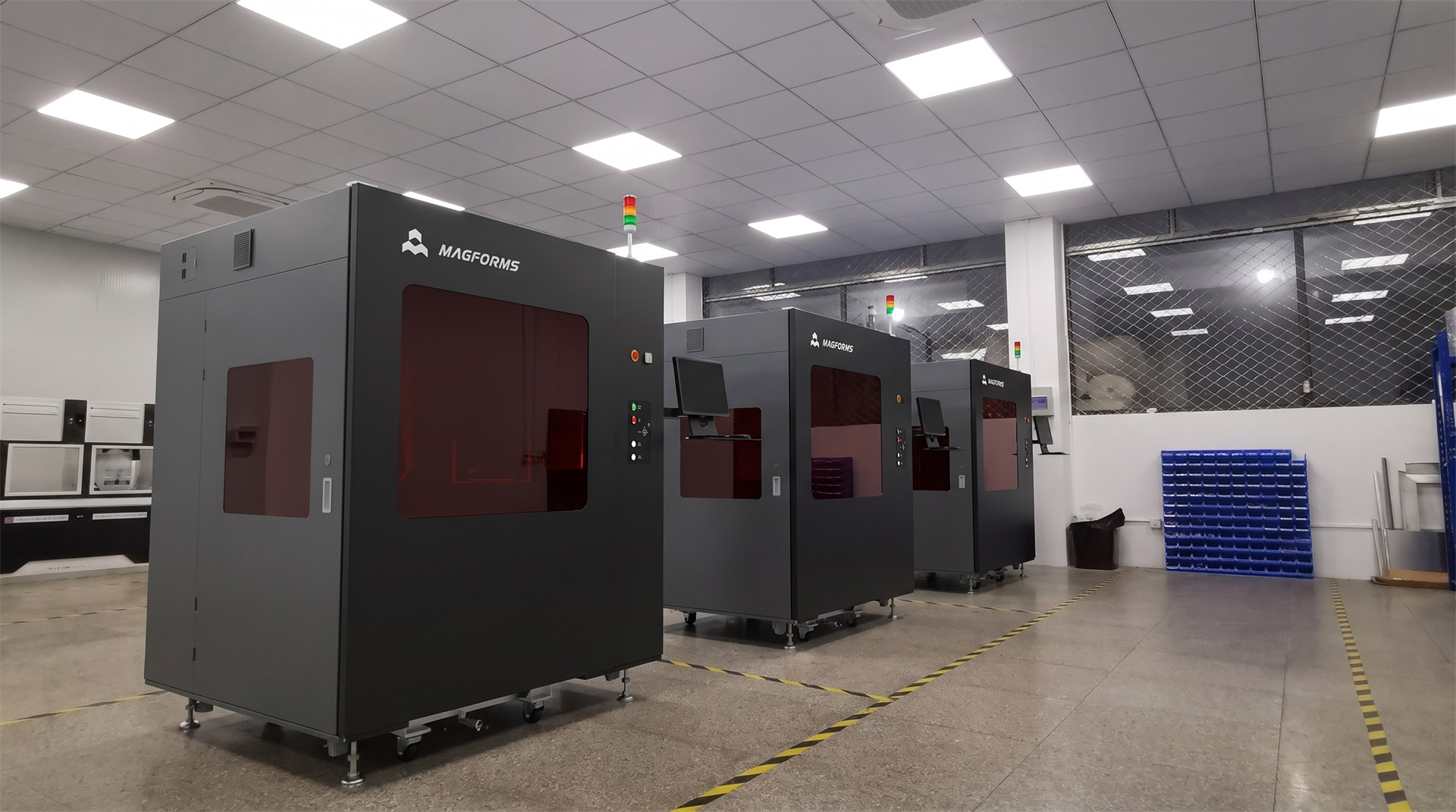
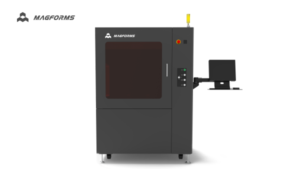
The Magforms SL800 is designed around a specific industrial requirement: producing larger parts while maintaining the flexibility expected from a production-oriented resin printing system.
Its 800 × 800 × 550 mm build volume provides substantially more working space for large prototypes, tooling masters, visual models, and multiple smaller components. For manufacturers producing large parts, this can reduce part splitting, secondary assembly, and the finishing work associated with joined sections.
The SL800 also uses variable laser spot technology. Different beam sizes can be used according to the printing requirement, helping balance scanning efficiency with detail. Magforms reports a 30–50% speed improvement compared with traditional SLA printing.
This is an important distinction when evaluating printer productivity. The objective is not simply to make the laser move faster, but to increase usable production output without sacrificing the required part quality.
Material flexibility is another part of the SL800’s industrial positioning. Its open material system is designed to work with most 355 nm resin materials, giving manufacturers greater freedom to evaluate compatible materials according to application requirements, supply availability, and cost.
The machine also uses industrial-grade components, including an AOC laser, Scanlab galvanometer system, Panasonic servo motors, and HIWIN linear guides. These components form part of the optical and motion-control architecture required for large-format industrial printing.
For detailed specifications and configuration options, explore the SL800 Industrial SLA 3D Printer.
SLA vs DLP for Different Industrial Applications
The better technology depends heavily on the type of parts being produced.
| Application | Better Fit | Why |
| Small dental models | DLP / SLA | High detail and compact build requirements |
| Jewelry patterns | DLP / SLA | Fine features and surface quality |
| Small precision components | DLP / SLA | Both technologies can provide great detail |
| Dense batches of small parts | DLP | Full-layer exposure can improve build efficiency |
| Large automotive prototypes | Industrial SLA | Large build volume reduces part splitting |
| Large equipment housings | Industrial SLA | More suitable for large individual components |
| Large visual models | Industrial SLA | Large-format capacity and surface quality |
| Large tooling masters | Industrial SLA | Fewer sections and less assembly |
| Mixed-size production | Industrial SLA | Greater flexibility across different part sizes |
| Flexible material requirements | Depends on system | Open-material capability can be a major advantage |
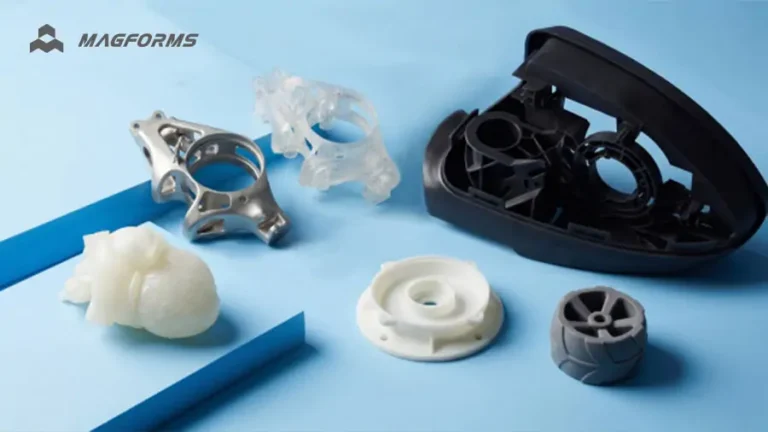
A real-world example shows why build volume can matter more than theoretical exposure speed. Magforms has documented an automotive component case study demonstrating the large-format capability of the SL800. This large-format capability can reduce assembly work, eliminate seams between joined sections, and help maintain better dimensional consistency across the finished component.

How to Choose Between SLA and DLP
The purchasing decision should start with your production requirements rather than the technology name.
Start with your production mix. Identify whether most of your jobs are small and detail-heavy or whether large components represent a significant portion of your workload. This determines how much value you can gain from full-layer DLP exposure versus a large-format SLA build area.
Look at the largest part you regularly produce. If large components need to be divided into multiple builds, compare the complete workflow, including assembly and finishing, rather than only printer cycle time.
Measure usable throughput. Calculate how many finished parts you can actually produce per production cycle. A printer with faster layer exposure is not necessarily faster at delivering completed parts.
Check material requirements. If you need multiple resin formulations, investigate whether the system provides an open material strategy and whether compatible materials have established process parameters.
Compare the complete workflow. Include supports, washing, post-curing, finishing, labor, maintenance, material consumption, and downtime. These factors can have a larger impact on production economics than the printer’s headline speed.
Finally, test representative parts before purchasing. Use your largest component, most detailed geometry, preferred material, and typical batch size. A side-by-side production test provides a much more reliable basis for equipment selection than comparing specifications alone.
Conclusion
So, Industrial SLA 3D Printer vs DLP: which is better for industrial applications?
The answer depends on what you produce.
DLP can be an excellent choice for compact, highly detailed parts where full-layer exposure provides a meaningful productivity advantage. For dental models, jewelry patterns, miniature components, and dense batches of small parts, it can deliver an efficient workflow.
An Industrial SLA 3D Printer becomes more compelling when production involves large parts, large-format prototypes, tooling masters, mixed-size jobs, material flexibility, and consistent results across a larger build area.
The Magforms SL800 addresses these requirements with an 800 × 800 × 550 mm build volume, variable laser spot technology, a reported 30–50% speed improvement, 355 nm resin compatibility, an open material system, and industrial-grade components.
The most important takeaway is this:
The fastest printer is not always the fastest way to finish the job. Choose the technology that produces your actual parts most efficiently.
For manufacturers whose workloads extend beyond small-format resin printing, evaluating a large-format Industrial SLA 3D Printer such as the SL800 with representative production parts can provide a clearer path to the right equipment decision.